
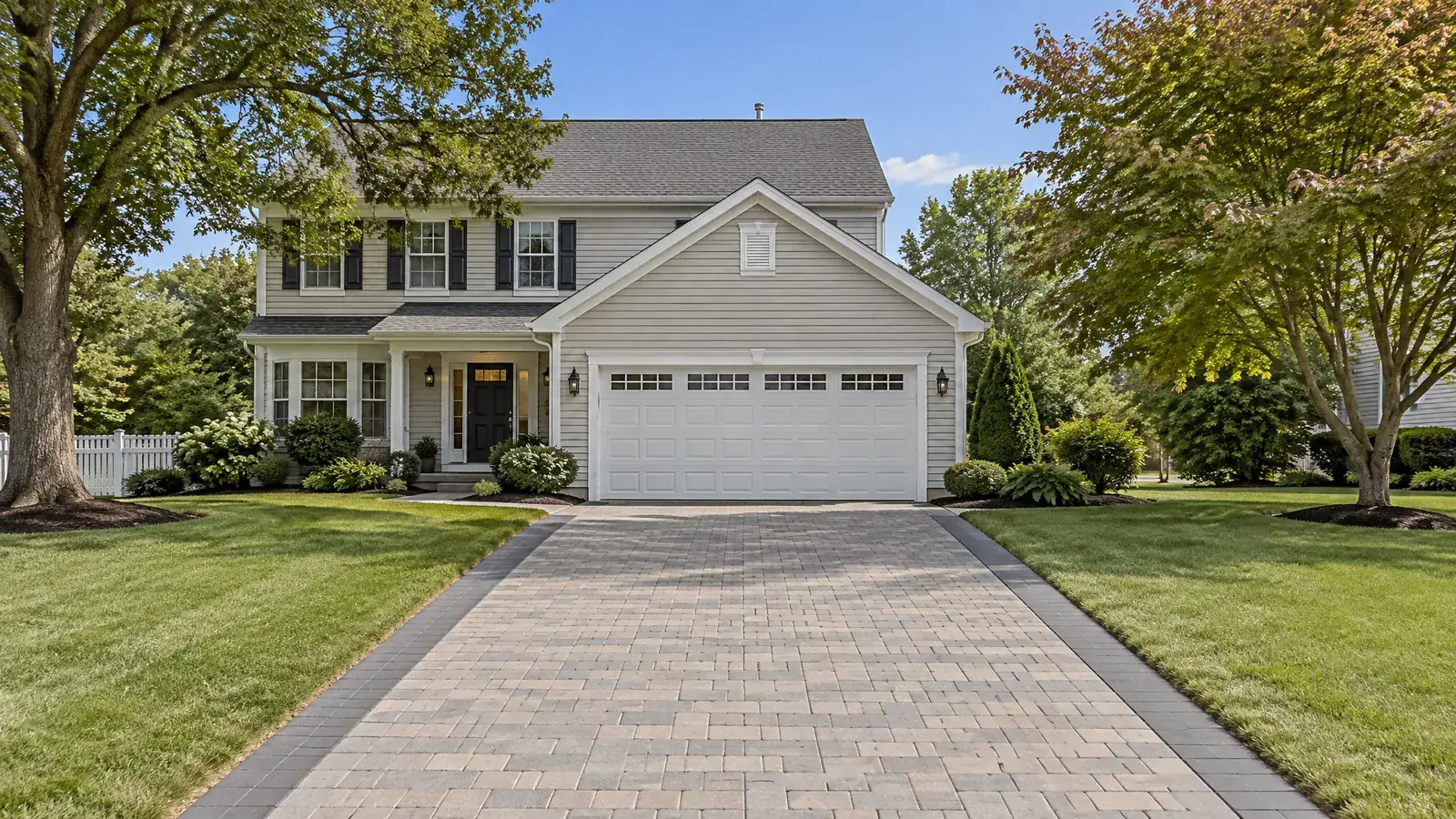
Pavers vs. Concrete for a Driveway in Maryland
A driveway is the largest hard surface most homeowners ever replace, and in Maryland it has to survive summer heat, winter freeze-thaw, snow plows and salt. The two most common choices for a replacement are poured concrete and interlocking concrete pavers. Both can last for decades when they are built well. Here is how they compare, so you can choose the right one for your home.
How each one is built
A concrete driveway is a single slab poured over a gravel base, with control joints cut so it cracks in straight lines instead of randomly. A paver driveway is made of individual units laid on a deep, compacted crushed-stone base, held in place by edge restraints and sand-filled joints. For a driveway, the base is dug deeper and built heavier than for a patio, because it has to carry vehicles.
Freeze-thaw and cracking
Maryland goes through many freeze-thaw cycles each winter. Water that gets under a slab freezes, expands and lifts it, and over the years that shows up as cracks and heaved sections. Pavers handle this movement differently: the joints let the surface flex a little, so a well-built paver driveway does not crack the way a slab does. Neither surface is immune to a poor base, which is why base depth matters more than the material on top.
Repairs
This is the biggest practical difference. When a concrete driveway cracks or settles, a repair is usually visible: a patch, a filled crack or a replaced section that does not quite match. With pavers, a damaged or stained unit can be lifted and replaced, and a settled area can be lifted, re-based and relaid with the same pavers. Utility work under a paver driveway is also easier to put back.
Drainage and ice
Both surfaces need the right slope away from the garage and the house. Concrete sends all water to the edges or a drain. Standard pavers also shed most water off the surface, while permeable pavers with open joints let water soak into a special stone base. On lots with clay soil, a channel drain in front of the garage or a French drain along the side is often the real fix for water and ice problems.
Salt and snow
De-icing salt can scale the surface of concrete, especially in its first winters. Quality concrete pavers are dense and handle salt well, though we still recommend using the least salt that does the job. Plows and shovels work on both; on pavers, a plow with a rubber edge is gentler on the border.
Curb appeal
Concrete is clean and simple, and it can be stamped or tinted. Pavers come in many colors, textures and patterns, and a contrasting border or apron can tie the driveway to the walkway and front steps. In neighborhoods such as Potomac, Bethesda and Olney, a paver driveway is often chosen because it matches the house and the rest of the hardscape.
Installation and use
A concrete driveway needs curing time before you can drive on it. A paver driveway can usually be used soon after the final compaction and joint sand, because there is nothing to cure. On the other hand, laying pavers takes more labor on site, which is part of why the two are quoted differently.
The apron and the street
Whichever material you choose, the apron where the driveway meets the street is in the public right of way in most places. Changing or widening it usually needs a separate right-of-way permit from the county or city, and in some towns the apron has to be built to their standard. We check the rules for your address before we schedule.
Which one should you choose?
- Choose concrete if you want a plain, uniform surface and accept that cracks may show over time.
- Choose pavers if you want easy, invisible repairs, a surface that flexes with freeze-thaw and a driveway that matches your walkways and patio.
- Either way, ask how deep the base will be, how the old driveway will be removed and how water will drain away from the garage.
Thinking about a new driveway?
Send a few details and, if you can, a photo of the area. We schedule a site visit and give you a written, itemized quote. Emerald Landscaping Corporation has served Montgomery, Howard and Frederick counties since 1998 (MHIC No. 120316).
Get my quote or call (301) 253-3239
More guides
Practical reading before you start a project.
How a Paver Patio Project Works, Step by Step
From the first call and site visit to design, approvals, excavation, base, laying and the final walkthrough: what to expect from a paver patio project.
Read the guide →
Why Pavers Sink on Maryland Clay, and How to Prevent It
Sunken and heaved pavers usually come from a thin base, poor compaction or water underneath. How clay soil causes it and how a patio should be built to last.
Read the guide →
How to Get HOA Approval for a Patio or Hardscape Project
What an HOA architectural committee usually asks for before a patio, walkway, driveway or wall, and how to prepare an application that gets approved.
Read the guide →