
Why Pavers Sink on Maryland Clay, and How to Prevent It
Low spots that hold puddles, edges that rise after winter and pavers that rock underfoot are some of the most common problems we are called to fix. On the clay soils found across Montgomery, Howard and Frederick counties, these problems almost always start below the surface. Here is what causes pavers to sink or heave, and how a patio, walkway or driveway should be built so it does not.
Why clay soil is hard on pavers
Clay holds water. When it is wet it gets soft and loses strength; when it dries in summer it shrinks and cracks. In winter, water held in the soil freezes and expands, which pushes the surface up, and when it thaws the ground settles again. Pavers set on a thin layer of sand over clay ride every one of those movements. After a few seasons the result is uneven joints, low spots and heaved edges.
The usual causes
- A base that is too thin. The crushed-stone base spreads loads and keeps water away from the clay. When it is skimped on, the soil underneath does all the work.
- Poor compaction. Stone dumped in one thick layer and compacted once settles later. A proper base is placed and compacted in lifts.
- Too much bedding sand. The sand layer under the pavers should be thin and even. A thick sand layer shifts and washes out.
- Water getting underneath. Downspouts emptying onto the patio, slope toward the house or a low corner of the yard all send water into the base.
- No edge restraint. Without a solid edge, the outside rows spread, the joints open and the field starts to move.
- Washed-out joints. Joint sand holds the pavers together. When it washes out, the units can rock and shift.
- Roots and old fill. Tree roots lift pavers, and builder fill or old organic soil under the base keeps settling for years. This is common on newer lots in Clarksburg, Urbana and other builder-graded subdivisions.
How a paver surface should be built
- Excavate to firm soil, removing topsoil and anything organic.
- Grade the subgrade so it slopes the same way the finished surface will, away from the house.
- Use filter fabric on soft clay where it helps keep the soil and the stone from mixing.
- Place crushed stone in lifts and compact each lift. Driveways get a deeper, heavier base than patios and walkways.
- Screed a thin, even bedding layer.
- Lay the pavers, install edge restraints and compact the surface.
- Fill the joints, usually with polymeric sand, and compact again.
- Handle the water: downspout lines, a channel drain or a French drain where the site needs it.
Can sunken pavers be fixed?
Usually, yes. In most cases we lift the affected pavers, find the cause, rebuild and compact the base, and reset the same pavers. Broken units are replaced with matching ones when possible. A full reset makes sense only when the base has failed across the whole area. Learn more about paver, brick and flagstone repair.
Questions to ask before you hire
- How deep will you excavate, and how thick is the compacted base?
- Do you compact the base in lifts?
- What edge restraint will you use?
- Where will the water from this area go?
If you are comparing quotes, our guide on what affects the cost of a paver patio explains why the base is worth paying for.
Pavers sinking or heaving?
Send a few details and, if you can, a photo of the area. We schedule a site visit and give you a written, itemized quote. Emerald Landscaping Corporation has served Montgomery, Howard and Frederick counties since 1998 (MHIC No. 120316).
Get my quote or call (301) 253-3239
More guides
Practical reading before you start a project.
How a Paver Patio Project Works, Step by Step
From the first call and site visit to design, approvals, excavation, base, laying and the final walkthrough: what to expect from a paver patio project.
Read the guide →
How to Get HOA Approval for a Patio or Hardscape Project
What an HOA architectural committee usually asks for before a patio, walkway, driveway or wall, and how to prepare an application that gets approved.
Read the guide →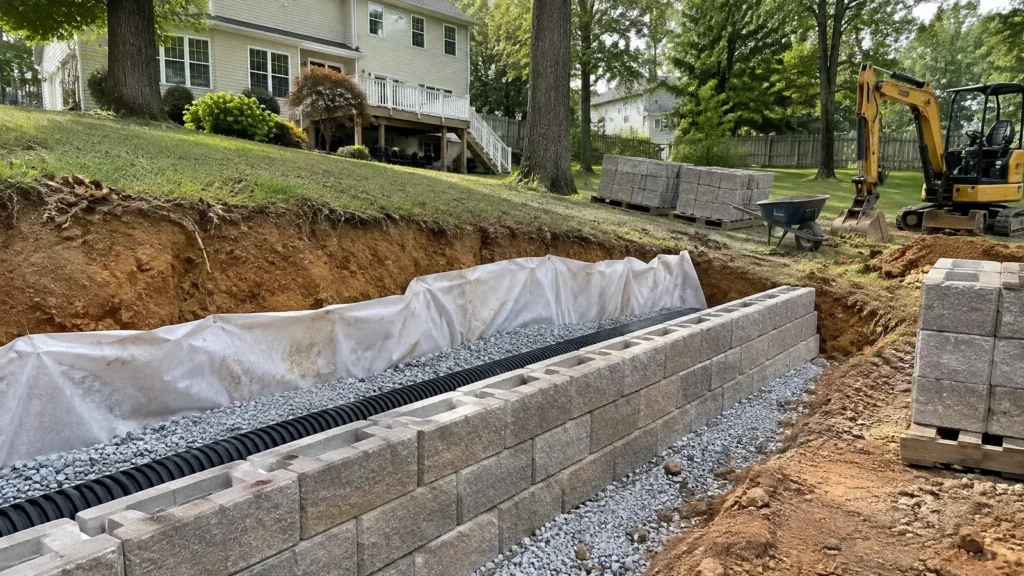
Do You Need a Permit for a Patio or Retaining Wall in Montgomery County, MD?
When a retaining wall, grading or a patio project needs a permit in Montgomery County, MD, and how cities like Rockville, Gaithersburg and Kensington differ.
Read the guide →